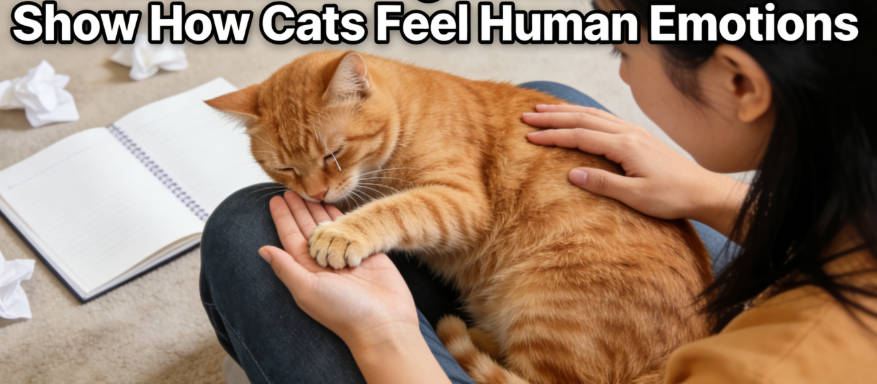
Many cat owners notice something special when they feel sad or emotionally overwhelmed—their cat suddenly appears nearby, watching quietly or offering unexpected comfort. This often raises a question: can cats really sense human emotions? The answer, according to both observation and behavioral research, is yes. Cats are particularly sensitive to changes in their owner's emotional state, especially sadness. When they detect emotional distress, they often respond with unique behaviors that express concern, companionship, and comfort.
Five Heartwarming Moments That Show How Cats Sense Human Emotions
1. The Slow Blink: A "Cat Kiss" of Reassurance
The first sign is the slow blink, sometimes called a "cat kiss." When a cat slowly blinks at you, it is expressing trust and relaxation. Studies suggest that cats may increase this behavior when their owners are feeling down, almost as if they are offering reassurance. This gentle gesture works similarly to a human smile and can help calm anxiety and emotional tension.
2. Rubbing Against Their Owner: A Calming Gesture
The second behavior is rubbing against their owner. When cats rub their face or body against a sad owner, they are not only marking their scent but also releasing calming pheromones. Experiments have shown that when owners cry, about 83% of cats will approach and rub against them, compared to only 37% during normal situations. This physical contact may even help reduce human stress hormones.
3. Unusual Companionship: A Shift in Behavior
Another touching behavior is unusual companionship. A typically independent or aloof cat might suddenly follow its owner everywhere or rest in places it normally avoids, such as a desk or bathroom. Veterinary behaviorists have found that cats can recognize changes in human facial expressions, and they tend to observe sad faces for nearly twice as long as happy ones.
4. Offering Gifts: A Caregiving Instinct
Some cats go even further by offering gifts. A cat might place a toy, a leaf, or even prey near its owner's feet. While this can seem amusing or strange, it is actually a caregiving instinct. In the wild, mother cats bring food to their kittens as part of nurturing behavior. Domestic cats may extend this instinct toward their human companions when they sense emotional vulnerability.
5. Emotional Synchronization Through Purring
Finally, there is emotional synchronization through purring. When a cat purrs while its owner is sad, the sound frequency—typically between 25 and 150 Hz—can have calming and therapeutic effects. This vibration range has been associated with relaxation and the release of endorphins in humans. Some cats may even adjust their breathing rhythm to match their owner's breathing, creating a subtle sense of emotional resonance.
Understanding Your Cat's Emotional Response
If your cat licks your tears or gently touches tear marks with its paws, it may be showing deep emotional empathy. However, it is important not to force interaction. Allowing the cat to comfort you at its own pace helps build genuine trust.
These small moments remind us that a cat's love is often quiet but deeply present. When your cat gently nudges your hand or stays close during difficult times, it may be its way of saying, "I understand your sadness, and I am here with you."

Comments (25)
John Doe
March 11, 2025This is such a heartwarming article! My cat always comes to me when I'm sad, and now I understand why. Thank you for sharing this information.
ReplyJane Smith
March 12, 2025My cat does the slow blink when I'm feeling down. It's so comforting to know that she's trying to reassure me. Great article!
ReplyLeave a Comment